
Score breakdown
Updated Aug 28, 2026Lex strips AI writing back to a clean, Google-Docs-like editor with AI you summon only when you want it. We tested it for focused drafting of fiction and long-form.
What is Lex?
Lex is a minimal AI-powered writing editor. It looks like a clean document, with AI available on command to continue text, give feedback, or brainstorm. It suits writers who want a distraction-free space rather than a busy AI dashboard.
What Lex does well
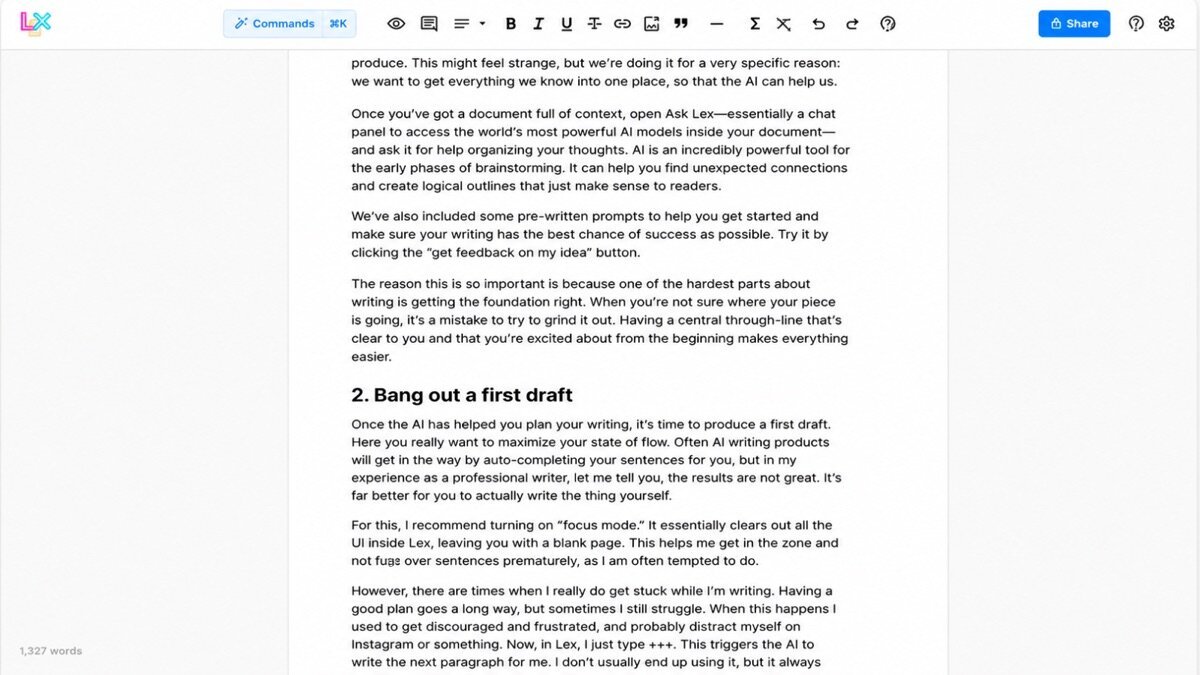
Distraction-free editor
A clean, focused writing space — the AI stays out of the way until you call it, which many writers prefer.
AI on command
Ask it to continue, critique, or brainstorm; useful for unblocking without breaking flow.
AI feedback
It can give editorial feedback on your draft, a nice touch for solo writers.
Where it falls short
It is lighter on fiction-specific features than Sudowrite and on structure than Squibler — it is a writing space with AI, not a full novel suite. Power users may want more.
Lex hands-on
For focused drafting, Lex was a pleasure — the calm interface kept us writing, and summoning AI to continue a stuck paragraph felt natural. It lacks Story Engine-style novel tooling, but as a distraction-free draft space with AI, it delivered.
How Lex scored on our rubric
Lex pricing
Lex has a free tier and paid plans from around $10/month. For a distraction-free AI editor, it is fairly priced, especially for writers who dislike cluttered tools.
Who should (and shouldn’t) use Lex
Buy it if you want a calm, focused writing space with AI available on demand.
Skip it if you need fiction-specific tooling or structure — Sudowrite or Squibler do more.
Lex alternatives
Full ranking: best AI fiction writing tools.
What’s new in Lex for 2026
Lex has added a choice of AI models, sharper feedback and critique features, and editor and collaboration improvements, while keeping its calm, document-first design. The additions make it more capable without cluttering the writing space — still the pick for writers who want focus with AI a keystroke away.
Getting the most out of Lex
- Write in its distraction-free editor and summon AI only when stuck.
- Ask it to continue a paragraph or critique a draft for quick unblocking.
- Pick the AI model that suits your task.
- Use it for focused drafting rather than heavy fiction tooling.
- Pair it with a dedicated fiction tool if you need worldbuilding features.
Lex in practice: focused drafting
Writing in Lex felt calm and fast — a clean page with AI a shortcut away when a paragraph stalled. Asking it to continue a thought or critique a section was smooth and genuinely helpful for momentum. It lacks a Story Bible or scene tools, so a novelist juggling a big world will want more; but for focused drafting of essays, blog posts, or prose, it is a pleasure to use.
Lex for different use cases
- Focused drafting: A calm space with AI on demand.
- Essays & nonfiction: Draft and get feedback without distraction.
- Getting feedback: AI critique on a draft for solo writers.
- Blog drafts: Fast, clean first drafts to refine.
How Lex compares
| Tool | Best for | Starts at | Our score |
|---|---|---|---|
| Lex | Distraction-free drafting | $10/mo | 8.2 |
| Sudowrite | Fiction prose | $19/mo | 8.9 |
| Novelcrafter | Long-novel organization | $8/mo | 8.3 |
Is Lex worth it?
At around $10/month with a free tier, Lex is fairly priced for a distraction-free AI editor, and the free tier lets you try it risk-free. Its value is in the writing experience rather than fiction-specific power; if you want a calm place to draft with AI help, it is worth it, but dedicated novelists will need more tooling elsewhere.
Lex FAQ
The verdict
Lex is the best pick for writers who want a calm, distraction-free space with AI on tap. It is not a full fiction suite, but for focused drafting it is a delight. We score it 8.2 out of 10.