
Score breakdown
Updated Aug 28, 2026Jasper is one of the longest-running AI writing platforms, and it has spent years positioning itself for marketing teams rather than hobbyists. We put it back on the test bench in 2026, running it on real scripts, blog drafts, and ad copy, to answer one question: with dozens of cheaper AI writers around, is Jasper still worth its premium price? Short answer: for high-volume content teams, yes. Here is the full breakdown.
What is Jasper AI?
Jasper is an AI content platform built around long-form writing, brand consistency, and team workflows. Where a general chatbot gives you raw text, Jasper wraps that in templates, a Brand Voice engine, a document editor, and integrations that fit into an actual content pipeline. It is aimed at marketers, agencies, and creators who publish constantly and need output that stays on-brand without heavy editing.
What’s new in Jasper for 2026
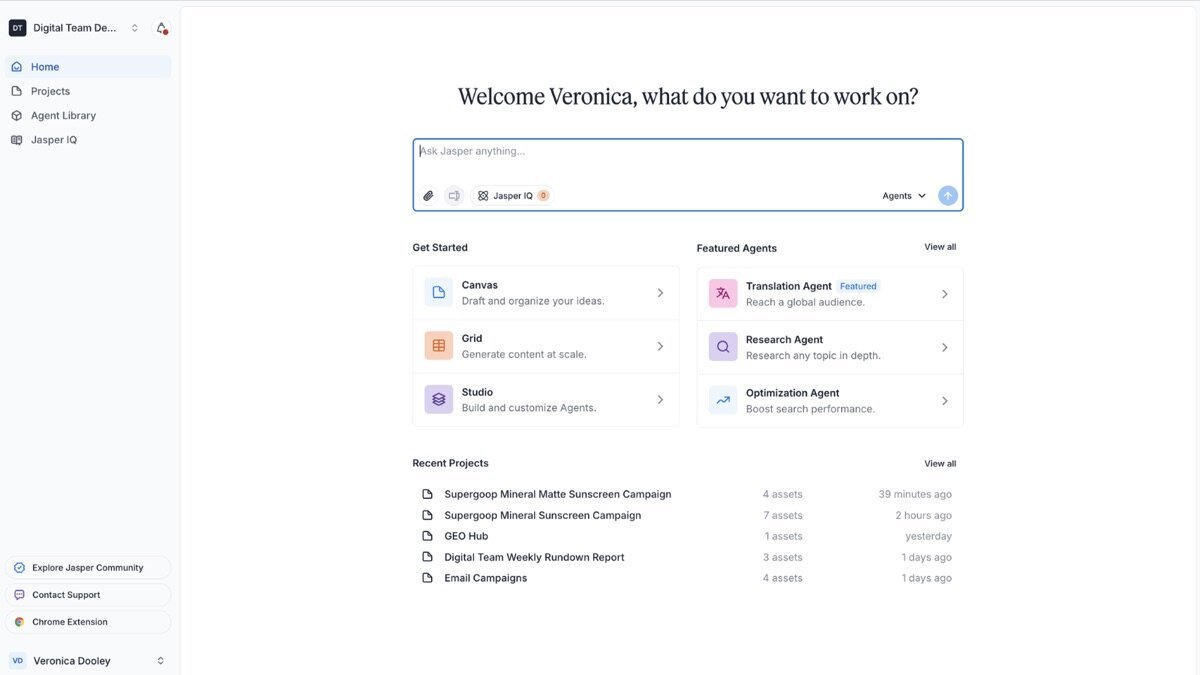
Jasper has shifted noticeably over the past year, and the changes matter if you last tried it a while ago. The editor is faster and less cluttered than the older version, and Brand Voice now needs fewer samples to lock onto your tone. The biggest practical change is how tightly workflows and the SEO mode are woven into the writing flow — you spend less time bouncing between screens and more time steering a draft.
Jasper has also leaned harder into being a team platform rather than a solo writing toy, with better seat management, brand-asset controls, and collaboration features on the higher tiers. For individual creators that adds complexity you may not need; for agencies and in-house teams it is exactly the direction that justifies the price. Underneath, the model quality has improved on nuance and instruction-following, which shows up most in fewer generic, filler sentences in a first draft.
What Jasper does well
Long-form consistency
This is Jasper’s strongest card. Across a 1,500-word draft it holds the thread far better than most competitors, which tend to drift or repeat themselves past the 800-word mark. The document editor lets you steer section by section, so you are guiding a draft rather than regenerating from scratch.
Brand Voice that actually holds
Feed Jasper a few samples of your writing and its Brand Voice feature genuinely keeps tone consistent across everything it produces. For a faceless channel, where the voice is the brand, this saved us the most editing time of any single feature.
Templates and workflows
With 50+ templates you are rarely staring at a blank page, whether you need a blog intro, a YouTube description, or a set of ad variations. The workflows chain these together, so a single brief can spin out a full content set.
Integrations
The Chrome extension puts Jasper inside Google Docs, your CMS, and email, and there is an API for teams that want to wire it into their own tools. In practice it means you stop copy-pasting between tabs.
Jasper hands-on: how it performed for us
We gave Jasper the same brief we use for a typical companion blog post: a 1,200-word explainer, in our voice, with an intro hook and three subheadings. With Brand Voice switched on, the first draft came back roughly 80% usable, which is high. Most of our editing was tightening, not rewriting, and the structure held from top to bottom.
Where it stumbled was factual precision on very recent, niche topics, where it occasionally stated things confidently that we had to correct. That is normal for AI writers, but worth saying plainly: Jasper speeds up drafting, it does not replace a fact check. For repeatable formats such as product roundups, video scripts, and email sequences, though, it was noticeably faster than writing from scratch.
We ran a second, tougher test: turning one long-form blog post into a week of derivative content — five social captions, a YouTube description, and a three-email sequence — all in the same brand voice. This is where Jasper’s workflows earn their keep. Instead of re-briefing the tool five times, we pointed it at the source piece and let a workflow fan it out. The captions needed the least editing; the email sequence needed the most, mainly to add specifics only we would know. Start to finish, it turned a half-day repurposing job into about an hour.
The lesson from both tests: Jasper is at its best on repeatable, structured content where consistency matters more than novelty. Ask it to be genuinely original or deeply technical and you will do more editing; ask it to reliably produce on-brand variations at speed and it is excellent.
Jasper pricing: is it worth it?
Jasper starts at $49/month for the Creator plan (one user, one Brand Voice), moves to $69/month for Pro (teams and multiple brand voices), and offers custom Business pricing with SSO, API access, and dedicated support. There is no permanent free plan, only a trial.
That is the crux of the value question. If you publish a handful of pieces a month, Jasper is hard to justify against tools like Writesonic or Rytr that cost less for comparable short-form output. But if you are shipping content weekly across several channels, the hours Brand Voice and workflows save you cover the cost quickly. The price is real, and so is the payback, provided you have the volume.
To put the price in context: the Creator plan works out to roughly $1.60 a day. If Jasper saves you even two hours of writing a week — a conservative estimate once Brand Voice is trained — and you value your time at $25 an hour, it has paid for itself several times over before you publish anything. That math flips for light users: at two or three pieces a month the time saved does not clear the subscription, which is exactly why we steer occasional writers toward a cheaper tool. The value is real, but it is volume-dependent, not universal.
Getting the most out of Jasper
Jasper rewards teams that set it up properly. A few things made the biggest difference in our testing:
- Train Brand Voice early. Feed it three to five of your best existing pieces before you write anything real. The jump in first-draft quality is the single biggest lever you have.
- Brief in specifics, not adjectives. “Write about our product” gives generic output; a tight brief with audience, angle, and key points gives copy you can almost ship.
- Use workflows for repeatable formats. Any content you produce weekly — roundups, scripts, newsletters — is worth saving as a workflow so you are not rebuilding the prompt each time.
- Always fact-check. Treat Jasper as a fast first-drafter, never a source of truth. Verify names, numbers, and recent events before publishing.
Jasper for different use cases
Whether Jasper is the right call depends a lot on what you actually publish. Here is how it holds up across the jobs creators most often hire it for.
- Bloggers & SEO content: A strong fit. Long-form coherence plus the built-in SEO mode means you can take a keyword to a structured, on-brand draft quickly. This is where most people get their money’s worth.
- YouTubers & scriptwriters: Very good, and our own main use. Brand Voice keeps scripts sounding like you across a whole channel, and workflows turn one script into a title, description, and social pack. Expect to edit for pacing and delivery.
- Marketing agencies: The best fit of all. Multiple brand voices, team seats, and workflows are built for running several clients without the output blurring together. The Pro and Business tiers exist for exactly this.
- Ecommerce & product copy: Good for volume. Product descriptions, category pages, and ad variations are fast to spin out, though you will want to inject real product specifics rather than trust generic claims.
- Solo creators on a budget: Often overkill. If you publish occasionally, Jasper’s price is hard to justify against a cheaper tool. Come back to it when your volume climbs.
Jasper alternatives worth considering
Jasper is not the only option, and the right pick depends on your volume and budget:
- Writesonic — cheaper, strong for short-form and SEO content. See our head-to-head comparisons for how it stacks up.
- Copy.ai — a simpler interface and generous entry pricing, better for solo creators. More in our tool reviews.
- Rytr — the budget pick if you only need occasional short copy.
If you want the full ranked shortlist, see our best AI writing tools guide.
Jasper vs Writesonic vs Copy.ai at a glance
| Tool | Starts at | Best for | Long-form | Free plan | Our score |
|---|---|---|---|---|---|
| Jasper | $49/mo | Teams publishing at scale | Excellent | No | 9.2 |
| Writesonic | $16/mo | Budget SEO & short-form | Good | Yes | 8.7 |
| Copy.ai | $36/mo | Solo creators, simple UI | Fair | Yes | TBR |
TBR = to be reviewed. Full Writesonic and Copy.ai reviews are on the way; pricing is indicative and set by each vendor.
Who should (and shouldn’t) use Jasper
Buy it if you run a content operation — a blog, newsletter, and social every week — and brand consistency across a team matters. That is exactly where Jasper earns its price.
Skip it if you only need the occasional caption or short post. Start with a cheaper tool and upgrade to Jasper when your publishing volume makes the math work.
How Jasper scored on our rubric
We put every tool through the same four-part scoring method. Here is how Jasper broke down, and why its weak spots did not sink the overall score.
The takeaway: Jasper loses a little on ease of use and entry-level value, but its output quality is the best in class, and for the audience it targets that is the criterion that matters most.
Jasper AI FAQ
The verdict
Jasper remains the most complete AI writing platform for serious content teams in 2026. It is not the cheapest option, and it will not fact-check itself, but for creators and marketers publishing at volume its long-form quality, Brand Voice, and workflows make it the tool we reach for first. We score it 9.2 out of 10.